Swarm intelligence: Ants
Swarm intelligence algorithms, are a family of nature-inspired algorithms. However, while evolutionary algorithms mimic genetic reproduction, swarm intelligence mimics the collective behavior of animals. When we observe the world around us, we see many life forms that are seemingly primitive and unintelligent as individuals, yet exhibit intelligent emergent behavior when acting in groups. An example of these life forms is ants. A single ant can carry 10 to 50 times its own body weight and run 700 times its body length per minute. These are impressive qualities; however, when acting in a group, that single ant can accomplish much more. In a group, ants are able to build colonies; find and retrieve food; warn other ants, show recognition to other ants, and use peer pressure to influence others in the colony. They achieve this through pheromones—essentially, dropping perfumes that signal other ants as they move. Other ants can sense these perfumes and change their behavior based on them. Ants have access to between 10 and 20 types of pheromones that can be used to communicate different intentions. Because individual ants use pheromones to indicate their intentions and needs, we observe complex emergent intelligent behavior when they are in groups.
Why ants work without a map
What makes ants fascinating is that no single ant needs a master plan. Each one reacts to local information, and the colony still produces coordinated behavior. That is the central intuition behind ant colony optimization: intelligence can emerge from many simple agents leaving useful signals in the environment for one another.
Ant Colony Optimization (ACO)
Ant colony optimization (ACO) algorithms simulate the emergent behavior shown in this experiment. In the case of finding the shortest path, the algorithm converges to a similar state, as observed with real ants. Swarm intelligence algorithms are powerful tools for solving optimization problems where the search space is vast, rugged, and finding an absolute best solution is mathematically difficult. These problems belong to the same broad class that genetic algorithms aim to solve, but the choice between the two often comes down to how the problem is encoded. Genetic Algorithms are typically better for discrete choices (like choosing which items to pack in a knapsack). Swarm Algorithms (like Particle Swarm Optimization) excel at continuous numeric problems (like tuning the exact floating-point weights of a neural network).
Imagine that we are visiting a carnival that has many attractions. Each attraction is located in a different area, with varying distances between them. Because we don’t feel like wasting time and walking too much, we will attempt to find the shortest paths between all the attractions.
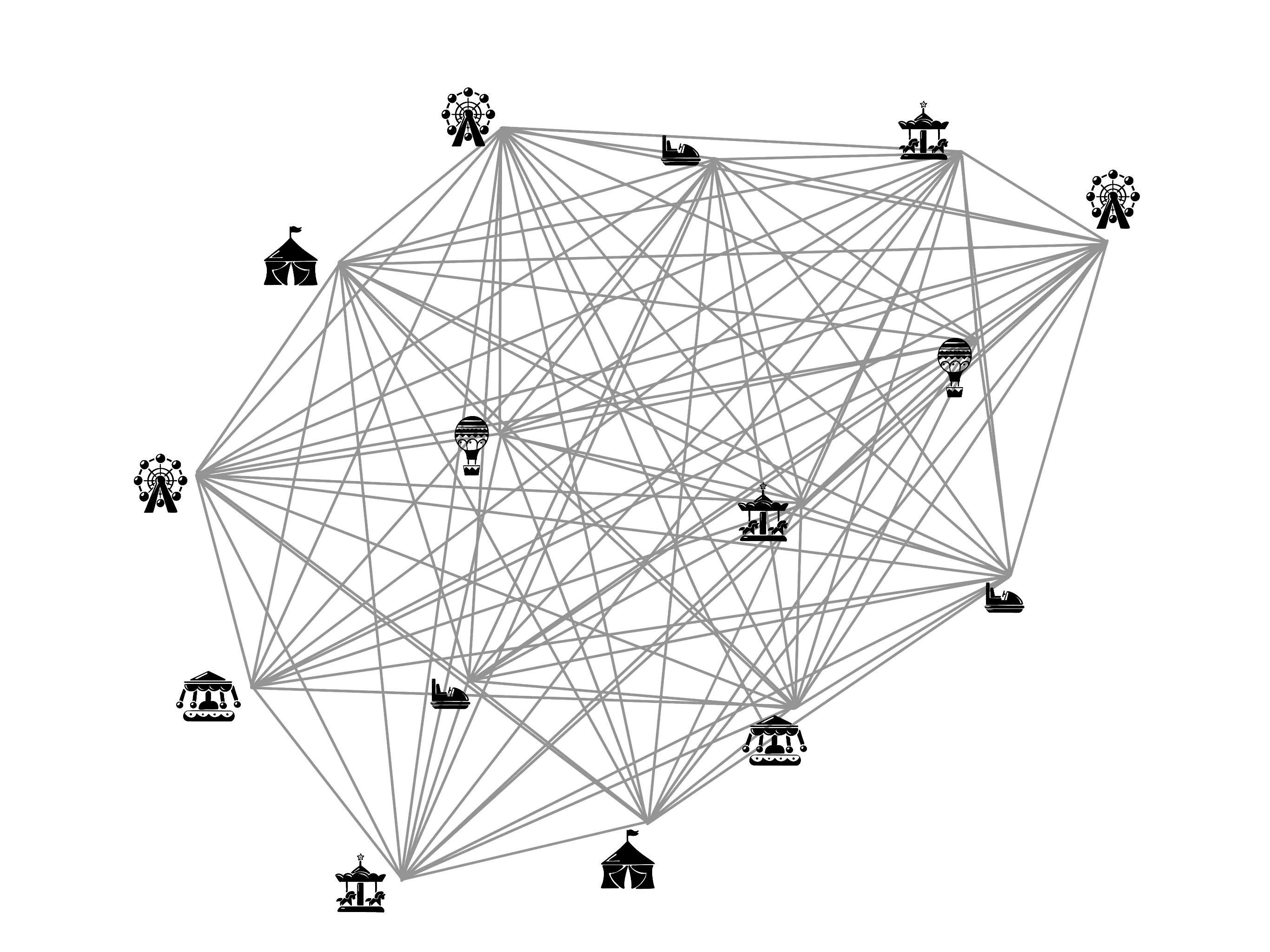
Visit the carnival better than the ACO
The simulation below lets you tap nodes to visit attractions and try to minimize the total distance traveled. The ACO tries to accomplish this by using pheromones to signal the best paths to take. The Reset button lets you start a new simulation with a random map. The Random route button lets you see how bad a random route performs based on an algorithm inspired by ants.
This toy keeps the environment clean and visible, but real route-planning problems often involve many more constraints such as timing, changing traffic, capacity limits, and imperfect information. The appeal of ACO is that the same core idea can still be adapted to those harder settings.
Pick a route or choose a random one to see how it compares to the ACO algorithm route.

Grokking AI Algorithms
How AI solves complex problems
A practical, visual guide to the algorithms that power search, machine learning, neural networks, LLMs, and generative AI.
Swarm Intelligence: Ants Frequently Asked Questions (FAQ)
What is ant colony optimization?
Ant colony optimization, or ACO, is an algorithm inspired by how ants find efficient routes using pheromone trails. It uses many simple agents whose local decisions combine into better global paths.
How do pheromones help solve routing problems?
Pheromones act like a distributed memory laid onto the environment. Stronger trails make good routes more likely to be reused, while evaporation keeps the algorithm from committing forever to poor early choices.
Why does evaporation matter in ACO?
Evaporation gradually weakens old pheromone trails. This prevents the algorithm from overcommitting to stale paths and helps it keep exploring alternatives.
What is the role of many ants instead of one search agent?
Multiple ants let the algorithm sample many candidate routes in parallel. That collective exploration makes it easier to discover promising patterns than relying on a single deterministic path.
Does ACO always find the shortest route?
Not necessarily. ACO is a heuristic optimization method, so it aims to improve solutions over time rather than guarantee the mathematically perfect route every run.
What kinds of problems is ACO good for?
ACO is especially useful for pathfinding and combinatorial optimization problems, such as routing, scheduling, and travel-style problems. It works well when many candidate paths must be compared and improved over time.
Why is ant-inspired search considered swarm intelligence?
The intelligence does not come from one complex agent. It emerges from many simple agents following local rules and influencing one another indirectly through the environment.
What is a local optimum in route search?
A local optimum is a solution that looks strong compared with nearby alternatives but is not the best possible overall. Swarm methods must balance reinforcement of good routes with enough exploration to escape these traps.
Why does ACO work without a central planner?
Each ant only needs local information and pheromone signals. Over time, those small decentralized updates accumulate into useful global structure.
What does the park-route simulation help you understand?
It makes the route-building and pheromone-reinforcement process visible. You can compare your own path choices with the algorithm's evolving best route.
What should I watch for in the demo?
Look at how the best route improves over generations and how repeated paths gain influence. That is the core ACO feedback loop made concrete.