Machine learning
Suppose that you’re looking for a new apartment. You speak to friends and family, and do some online searches for apartments in the city. You notice that apartments in different areas are priced differently. Here are some of your observations from all your research:
- A one-bedroom apartment in the city center (close to work) costs $5,000 per month.
- A two-bedroom apartment in the city center costs $7,000 per month.
- A one-bedroom apartment in the city center with a garage costs $6,000 per month.
- A one-bedroom apartment outside the city center, where you will need to commute to work, costs $3,000 per month.
- A two-bedroom apartment outside the city center costs $4,500 per month.
- A one-bedroom apartment outside the city center with a garage costs $3,800 per month.
You notice some patterns. Apartments in the city center are most expensive and are usually between $5,000 and $7,000 per month. Apartments outside the city are cheaper. Increasing the number of rooms adds between $1,500 and $2,000 per month, and access to a garage adds between $800 and $1,000 per month.
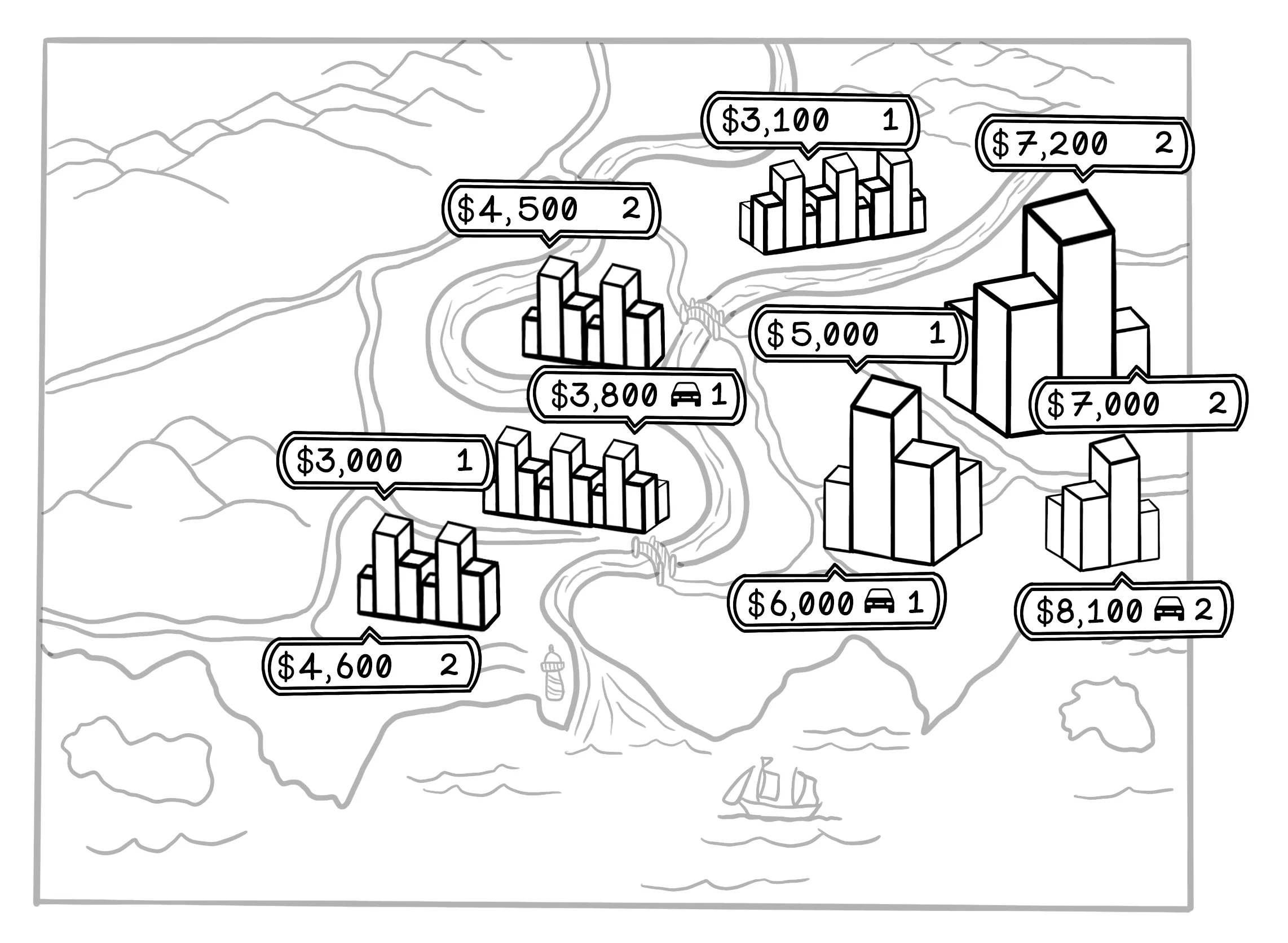
This example shows how we use data to find patterns and make decisions. If you encounter a two-bedroom apartment in the city center with a garage, it’s reasonable to assume that the price would be approximately $8,000 per month.
Machine learning aims to find patterns in data for useful applications in the real world. We could spot the pattern in this small dataset, but machine learning spots them for us in large, complex datasets.
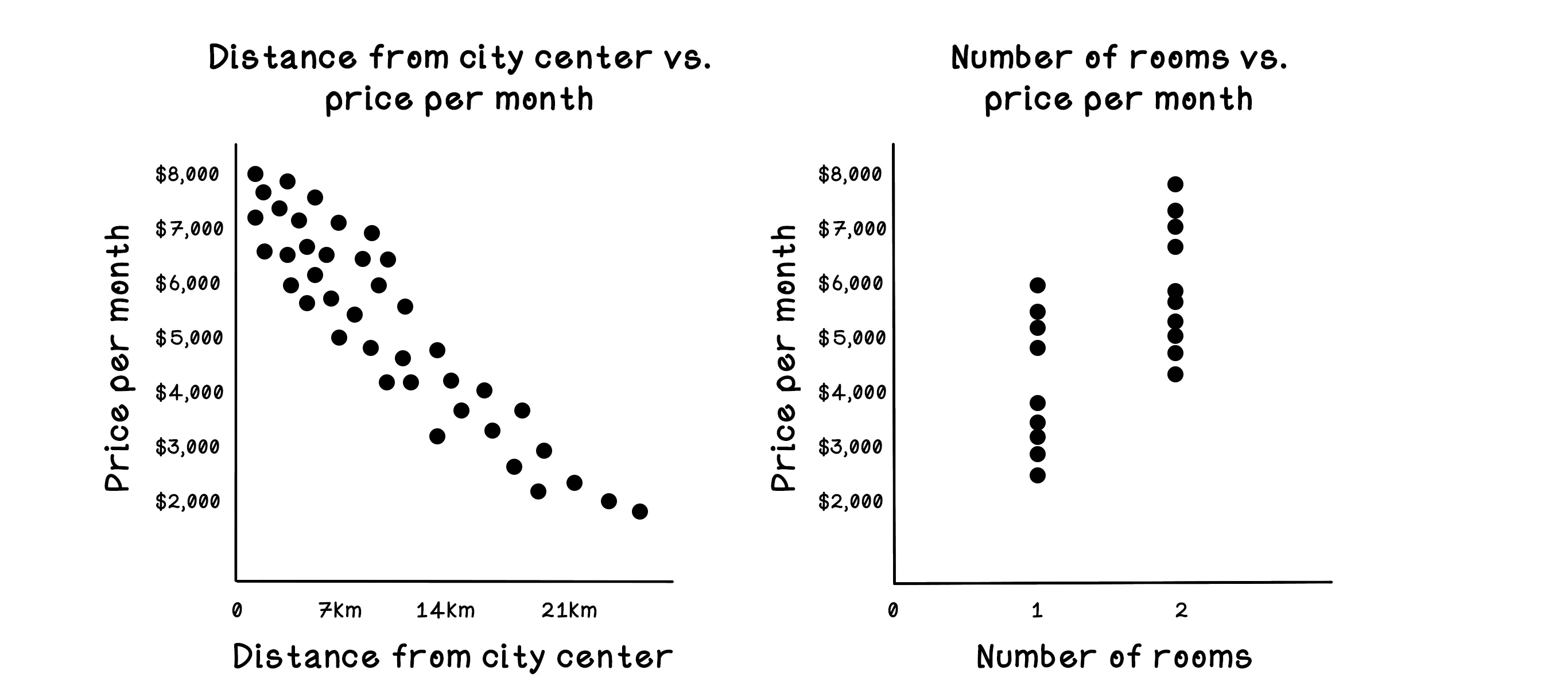
Notice that there are more dots closer to the city center and that there is a clear pattern related to price per month: the price gradually drops as distance to the city center increases. There is also a pattern in the price per month related to the number of rooms; the gap between the bottom cluster of dots and the top cluster shows that the price jumps significantly. We could naïvely assume that this effect may be related to the distance from the city center. Machine learning algorithms can help us validate or invalidate this assumption. We dive into how this process works throughout this chapter.
Choosing an algorithm to use is based largely on two factors: the question that is being asked and the nature of the data that is available. The apartment example builds intuition for the general idea of pattern-finding in data. For the actual toy on this page, we switch to diamonds because the relationship between carat and price gives us a clean one-feature regression problem that is easier to visualize step by step. If the question is to make a prediction about the price of a diamond with a specific carat weight, regression algorithms can be useful. The algorithm choice also depends on the number of features in the dataset and the relationships among those features. If the data has many dimensions, we can consider several algorithms and approaches.
Regression means predicting a continuous value, such as the Price or Carat of the diamond. Continuous means that the values can be any number in a range. The price of $2,271, for example, is a continuous value between 0 and the maximum price of any diamond that regression can help predict.
Linear regression is one of the simplest machine learning algorithms: it finds relationships between two variables and allows us to predict one variable given the other. Here, that means predicting the price of a diamond based on its carat value. By looking at many examples of known diamonds, including their Price and Carat values, we can teach a model the relationship and ask it to make predictions.
| Diamond | Carat | Price |
|---|---|---|
| 1 | 0.71 ct | $1,643 |
| 2 | 0.70 ct | $2,241 |
| 3 | 0.61 ct | $931 |
| 4 | 0.30 ct | $1,013 |
| 5 | 0.24 ct | $419 |
| 6 | 2.00 ct | $12,576 |
Let’s start trying to find a trend in the data and attempt to make some predictions. For exploring linear regression, the question we’re asking is “Is there a correlation between the carats of a diamond and its price, and if there is, can we make accurate predictions?”
Why training beats guessing
At first glance, it may feel like we could just draw a reasonable line through the points by eye and be done. That works when the dataset is tiny and the pattern is obvious. But once the data becomes larger, noisier, and less intuitive, manual guessing stops being reliable. Training gives us a systematic way to improve a model based on error rather than intuition alone.
We start by isolating the Carat and Price features and plotting the data on a graph. Because we want to find the price based on Carat value, we will treat carats as x and price as y. Why did we choose this approach?
Carat as the independent variable (x) — An independent variable is one that is changed in an experiment to determine the effect on a dependent variable. In this example, the value for carats will be adjusted to determine the price of a diamond with that value.
Price as the dependent variable (y) — A dependent variable is one that is being tested. It is affected by the independent variable and changes based on the independent variable value changes. In our example, we are interested in the price given a specific carat value.
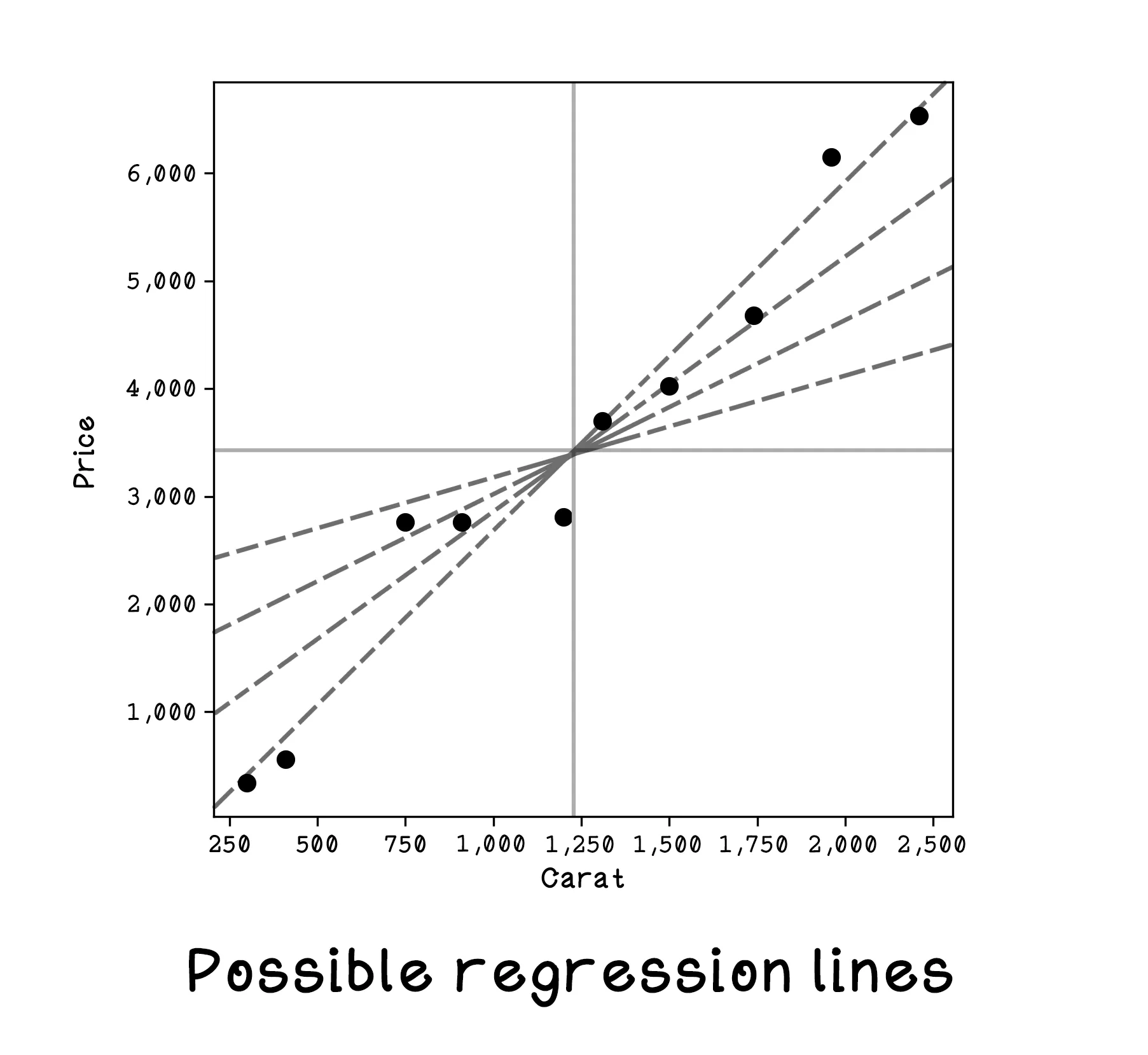
Linear regression will always find a straight line that fits the data to minimize distance among points overall. Understanding the equation for a line is important because we will be learning how to find the values for the variables that describe a line.
A straight line is represented by the equation y = c + mx:
- y: The dependent variable
- x: The independent variable
- m: The slope of the line
- c: The y-value where the line intercepts the y axis
Start the model and watch the regression line move as training progresses. The key things to watch are the loss curve and the fit of the line to the scatter plot. With a reasonable learning rate, the line should steadily rotate and shift toward the overall trend in the data. If the learning rate is too low, training crawls. If it is too high, the line can overshoot and wobble instead of settling down.
Reset the model a few times and compare different learning-rate values. That is the easiest way to build intuition for gradient descent: the model is not magically discovering the answer all at once, it is taking repeated small corrective steps based on error.
This toy uses just one feature so the relationship is easy to see, but most real machine learning problems involve multiple interacting variables, messy data, and examples that do not line up neatly. That is what makes the jump from simple regression to richer models so important.

Grokking AI Algorithms
How AI solves complex problems
A practical, visual guide to the algorithms that power search, machine learning, neural networks, LLMs, and generative AI.
Machine Learning Frequently Asked Questions (FAQ)
What is linear regression?
Linear regression is a machine learning method that fits a straight line to model the relationship between an input and an output. In this chapter, it is used to connect diamond carat size to price.
What does regression mean in machine learning?
Regression means predicting a numeric value rather than a category. Examples include estimating price, temperature, demand, or any other continuous quantity.
Why does machine learning need training?
Training adjusts the model's parameters so its predictions better match the data. Instead of guessing the slope and intercept by hand, the algorithm learns them from examples.
What are the slope and intercept in a line of best fit?
The slope controls how sharply the prediction changes as the input changes, and the intercept is the baseline value where the line crosses the vertical axis. Together they define the model's prediction rule.
What is a loss function?
A loss function measures how wrong the model's predictions are. Lower loss means the model is matching the training data more closely.
What does gradient descent do?
Gradient descent updates the model step by step to reduce prediction error. The learning rate controls how big each update is, which is why it strongly affects how quickly and how stably the model learns.
What is a learning rate?
The learning rate controls the size of each update during training. If it is too small, learning is slow; if it is too large, the model can overshoot and behave unstably.
Why normalize data in a machine learning demo?
Normalization helps keep values on manageable scales so optimization behaves more smoothly. It often makes training faster and easier to interpret.
Is linear regression enough for all machine learning problems?
No. It is one of the simplest and most useful starting points, but many real problems require more flexible models when relationships are nonlinear or more complex.
What does the chapter simulation help you understand?
It makes model fitting visible. You can watch the line move, see the loss change, and connect abstract training terms to concrete behavior.
Why start a book on machine learning with linear regression?
Because it reveals the core learning loop clearly. Once you understand inputs, outputs, parameters, error, and iterative improvement here, more complex models become much easier to follow.